Grounded Dreams: The Show-Stopping Concept Cars That Never Hit the Road
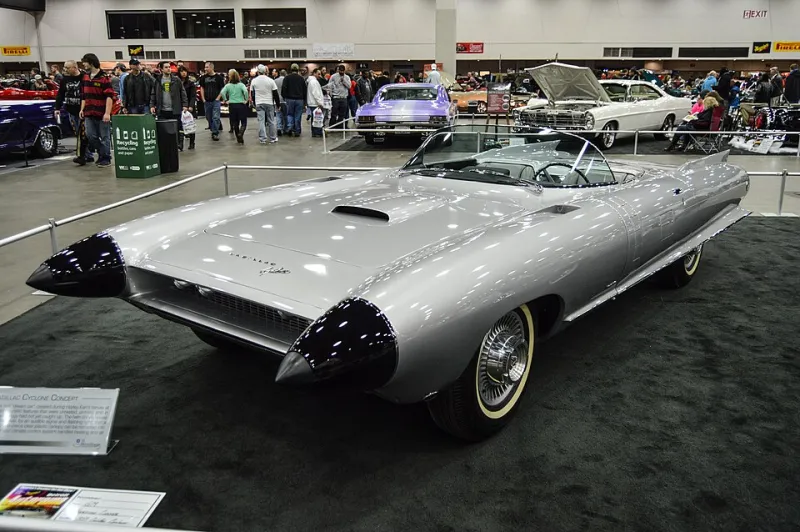
Photo: Yahya S. from United States, CC BY 2.0, via Wikimedia Commons
There's a special kind of heartbreak in the automotive world: the concept car that never made it. These are the machines that packed auto show floors in Detroit and Los Angeles, made magazine covers, and then quietly vanished into museum basements and private collections. Today, we're giving them the gallery treatment they deserve — full-res wallpapers, quick spec breakdowns, and the honest story of why each one never reached a showroom.
The Cadillac Cyclone: Jet Age on Four Wheels
Let's start with the loudest statement of the 1950s. The 1959 Cadillac Cyclone looked like it was about to lift off — nose cones pulled from fighter-jet design language, headlamps hidden under canopies, and a radar unit mounted up front that GM claimed could detect objects in the road.
Quick specs:
- 390 cubic-inch V8, roughly 325 hp
- Power sliding canopy instead of conventional doors
- Front and rear bumpers merged into those dramatic tailfins
Why it never happened? Simple: radar-guided safety tech cost a fortune, and the canopy leaked in the rain. But boy, does it photograph well. Our gallery shots capture that chrome from every angle — it's basically a mirror on wheels.
The Dodge Deora: A Pickup From Another Planet
The Deora is proof that concepts don't have to come from a corporate design studio to become legends. Built by the Alexander Brothers custom shop in Michigan and debuted in 1967, this forward-control pickup had no conventional doors — you climbed in through the windshield section, which tilted forward.
Quick specs:
- Based on a Dodge A100 pickup
- 273 cubic-inch V8 mounted behind the cab
- Loaded via a flip-up tailgate that doubled as a ramp
It never went into production for obvious reasons — nobody at Chrysler wanted to explain a windshield-entry pickup to insurance companies. It did become a Hot Wheels original, which might be a better legacy anyway. Scroll through the gallery and check the proportions; photos shot at ground level really sell the wedge profile.
The Plymouth XNR: Asymmetric and Unapologetic
A 1960 concept with a headlight arrangement that wasn't even symmetrical? The XNR, styled under Virgil Exner's direction, leaned into the offbeat. It was a small roadster meant to go toe-to-toe with imported sports cars — think Corvette's scrappy little cousin.
Quick specs:
- Slant-six engine, upgraded for the show circuit
- Fiberglass body with a distinctive offset driver's headrest
- Sub-2,000-pound curb weight
The reason it died is almost funny: the market for American-built small sports cars just wasn't there in 1960, and Chrysler's money went elsewhere. The car itself survived, eventually restored and shown at Pebble Beach decades later. Our wallpaper picks highlight that headrest fin — you won't see anything like it today.
The Ford Gyron: Two Wheels, One Wild Idea
Not every concept needed four wheels to make a statement. The 1961 Ford Gyron was a two-wheeled gyroscopically stabilized dream, styled by Alex Tremulis — the same mind behind the Tucker. It was pure futurism, complete with a single-seat cockpit and instrumentation that looked borrowed from an aircraft.
Quick specs:
- Two-wheel gyroscopic balance (never actually functioned on the real car)
- One-seat cockpit with a full instrument array
- Body built by Brooks Stevens' shop
It never ran under its own power, and it never needed to. The Gyron was a design exercise, a way for Ford to plant a flag in the future. The gallery photos from the original auto show floor are some of the rarest in our archive.
Why We Love the Ones That Got Away
There's a case to be made that concept cars that never made it are more fun than the ones that did. No compromises, no cost engineering, no federal bumper regulations. Just designers at the peak of their confidence, drawing the future with a straight face.
Every image in this gallery is available in full resolution for your desktop or phone wallpaper. Whether you're a fan of tailfin excess, wedge-era minimalism, or just love a good automotive what-if, this archive has something worth saving.
Which one would you have actually bought new? Drop a comment — and keep an eye on the site, because we've got more never-produced legends queued up in the next gallery drop.
