Before the Minivan and the SUV, America Rode in the Back of a Station Wagon
There's a particular kind of photo that lives in every American family album: the rear hatch of a station wagon wide open, suitcases stacked to the ceiling, a golden retriever half-visible behind them, and somebody's dad squinting into the camera. For roughly 40 years, that image was the American road trip.
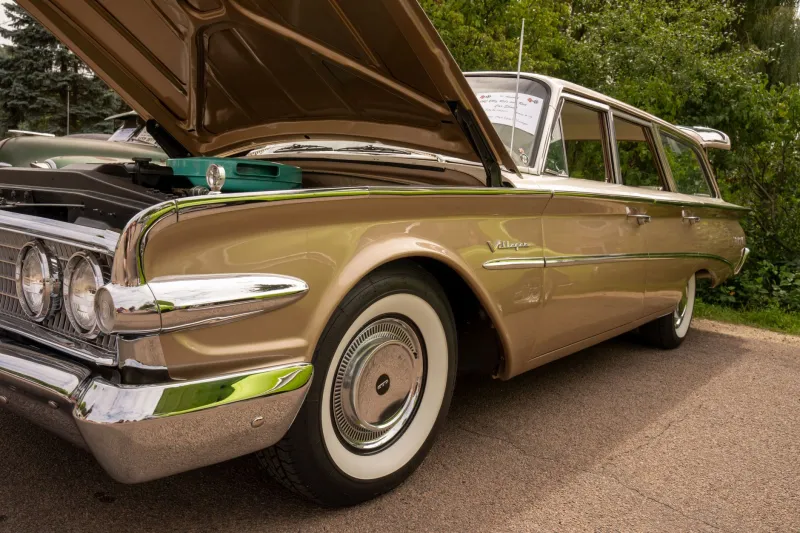
Scroll through our latest gallery and you'll see it all — the Nomad's chrome-trimmed roofline, the Country Squire's unmistakable faux wood siding, a Vista Cruiser with its greenhouse of glass. These are cars built for a very specific job: hauling an entire household across state lines without complaint. And honestly, they did it better than anything that came after.
The Golden Age of the Longroof
Station wagons weren't always family cars. In the early days, they were wooden, hand-finished utility vehicles — literally built by woodworkers — used by hotels and railroads to shuttle passengers and luggage. Hence the name.
By the 1950s, though, steel had replaced timber, and the suburbs were booming. Levittown-style neighborhoods sprouted across the country, and every one of them seemed to have a wagon in the driveway. Automakers noticed. Suddenly there was a wagon in nearly every showroom, from stripped-down workhorse versions to plush, chrome-laden haulers that cost real money.
The undisputed king of the era was the Chevrolet Nomad. Introduced in 1955 as part of the legendary Tri-Five lineup, it shared its gorgeous bodywork with the Bel Air but wore a unique, sporty roofline with wraparound rear glass. It was a two-door wagon with the presence of a show car — and today, original Nomads are among the most collectible Chevrolets on the planet.
Faux Wood and Fake Luxury: The Country Squire Era
If the Nomad was the glamour model, the Ford Country Squire was the people's champion. From the 1950s through the early '90s, its signature was the simulated wood-grain side paneling — vinyl over steel, but somehow completely convincing to a kid staring out the back window. At its peak in the 1960s and '70s, the Country Squire regularly sold in the hundreds of thousands of units a year.
These weren't small cars. A loaded Country Squire rode on a wheelbase longer than some modern full-size pickups, usually powered by a big V8, and could swallow a family of nine with room left over for a cooler. Chrysler countered with the Town & Country, Plymouth offered the Sport Suburban, and GM's divisions each had their own take — including Buick's superb Sport Wagon and Oldsmobile's Vista Cruiser, whose raised roof and skylight glass made the back seat the best seat in the house.
And let's not forget the rear-facing third-row seat. Generations of kids grew up watching the road disappear behind them, faces pointed backward at oncoming traffic. It was, by every modern safety standard, a terrible idea. It was also, apparently, a blast.
Why They Vanished
The wagon's decline didn't happen slowly — it happened almost all at once.
The first blow came in 1984, when Chrysler introduced the minivan. It offered the same seating capacity, similar cargo room, and — critically — it fit in a standard garage and drove more like a car. Families defected in droves. Then, in the 1990s, the SUV arrived with four-wheel drive, a commanding view of the road, and a marketing message that resonated: adventure, capability, toughness. Nobody was making movies about a Toyota Previa climbing a mountain.
By the mid-'90s, the longroof was effectively dead in the US market. The Country Squire ended production in 1991. The Caprice wagon followed in 1996 — the same year the minivan and SUV had fully taken over the family driveway.
Why We Still Love Them
There's a case to be made that the station wagon was simply a better idea than what replaced it. Lower center of gravity, better fuel economy, easier loading, car-like handling — the modern crossover is, functionally, a wagon that got a lift kit and a better publicist.
That's part of why these cars photograph so well, and why our gallery is filled with them. A 1957 Nomad in matador red. A '68 Country Squire with eight people and a boat in tow. A Vista Cruiser parked at a drive-in. These are images of a specific American moment, and the cars carried that moment on their long, level roofs.
So take a scroll through the gallery, grab a wallpaper or three, and enjoy the view from the way-back seat.