The Last Box Standing: A Photo Tribute to GM's G-Body Icons
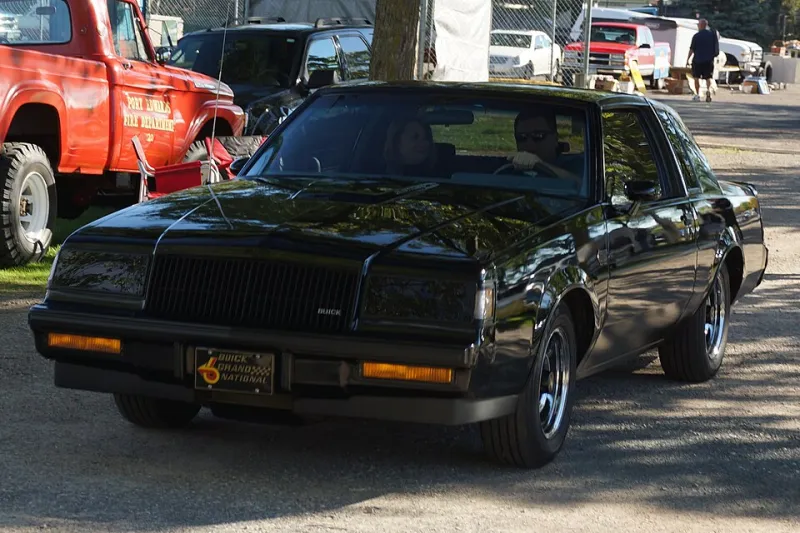
Photo: Greg Gjerdingen from Willmar, USA, CC BY 2.0, via Wikimedia Commons
There's a certain magic to a car that doesn't try too hard. GM's G-body family—the Monte Carlo, Cutlass, Regal, Grand Prix, and Malibu—spent the late 1970s and most of the 1980s looking squarely at the camera while the rest of the industry got busy rounding off every corner. And you know what? That square-jawed confidence has aged surprisingly well. In a world of jelly-bean crossovers, these rear-drive boxes stand out like a crisp black-and-white portrait in a feed full of filters.
This is the case for the G-body as a gallery star: not because it was the fastest or the flashiest, but because it was honest, handsome, and endlessly photogenic. Grab a coffee, scroll slow, and let's dig into the details that make these cars worth a second look.
One Platform, Five Very Different Personalities
Underneath, the 1978–1988 G-bodies shared a 108.1-inch wheelbase and a familiar rear-drive layout. On top, GM's divisions each wrote their own version of the same story. That's the fun part for photo hunters—the family resemblance is there, but the faces are distinct.
- Chevrolet Monte Carlo: The sleek one. The 1978 downsizing brought a more formal roofline and a NASCAR-flavored swagger. The 1983–1988 Monte Carlo SS, with its nose cone, rear spoiler, and 305-cubic-inch V8, is the poster child. Expect 180 horsepower in most SS years—not a monster, but enough to feel alive.
- Oldsmobile Cutlass Supreme: The volume leader. Clean lines, comfortable proportions, and a huge trim ladder. The 1983–1984 Hurst/Olds and later 442 models bring the visual heat with two-tone paint, special wheels, and the kind of graphics that make for great detail shots.
- Buick Regal: The sleeper. The Grand National and GNX turned the boxy Regal into a turbocharged legend. The 1987 GNX's 276-horsepower 3.8-liter turbo V6 is the headline, but even standard T-Type models photograph like they're up to something.
- Pontiac Grand Prix: The smooth operator. The 1986–1987 Grand Prix 2+2 added a slippery nose and rear glass that looks like it belongs on a stock car. Rare, weird, and fantastic in a wide-angle shot.
- Chevrolet Malibu: The workhorse. Sedans and wagons did the daily-duty thing, and today they're the blue-collar heroes of the family. A clean Malibu wagon with rally wheels is a wallpaper waiting to happen.
Trim Levels Worth Hunting in the Wild
The G-body hierarchy is a rabbit hole, but a few names deserve the spotlight.
Monte Carlo SS (1983–1988): The gateway drug. Look for the bulging front fascia, the rear spoiler, and the 15-inch five-spoke wheels. White with blue stripes? Orange with black? You really can't go wrong.
Buick Grand National (1984–1987) and GNX (1987): All black, all business. The Grand National's monochrome look is a photographer's dream—every chrome accent and badge pops. The GNX adds fender flares, a ladder bar, and the kind of mythos that makes grown adults whisper "turbo" at car shows.
Oldsmobile Hurst/Olds (1983–1984): Silver and black two-tone, lightning-bolt graphics, and T-tops on some examples. It's peak 1980s in the best possible way.
Pontiac Grand Prix 2+2 (1986–1987): A nose that looks like it's trying to cheat the wind, and a rear window that could double as a coffee table. Only around 1,100 were built across both years, so spotting one is a treat.
Malibu wagon: Don't sleep on it. With roof rails, woodgrain siding, and steel wheels, it's a rolling slice of American suburbia. Perfect for a golden-hour roller shot.
Specs That Still Matter
Nobody is calling a stock G-body a track weapon, but the numbers are part of the charm.
- Layout: Front engine, rear-wheel drive
- Wheelbase: 108.1 inches
- Length: Roughly 200–202 inches depending on model and year
- Curb weight: About 3,200–3,600 pounds
- Engines: 3.8-liter V6, 4.3-liter V6, 5.0-liter V8, 5.7-liter diesel V8 (yes, really), and the turbocharged 3.8-liter V6
- Transmissions: Three- and four-speed automatics, plus manual options on some early models
That rear-drive layout is why enthusiasts still care. The G-body is simple, tunable, and friendly to a Saturday-morning wrench session. It's also why the cars look right from almost any angle—the proportions are honest, with a long hood, a short deck, and a stance that doesn't need air suspension to look cool.
Photo-Spotting Notes for Your Next Gallery Walk
If you're shooting a G-body—or just browsing listings with a photographer's eye—here's what to look for.
The front three-quarter. This is the money shot. The Monte Carlo SS nose and the Grand National's flat face both love a low, slightly off-axis angle. Get down near the headlight height and let the boxy fenders fill the frame.
The rear three-quarter. The Grand National's spoiler, the Monte Carlo SS's decklid, and the Cutlass's taillight panel are all worth a dedicated frame. Look for clean panel gaps and straight bumper fillers—cracked fillers are the G-body tell.
The profile. These cars are long, low, and square. A side-on shot emphasizes the proportions in a way that modern cars can't match. Find a clean wall or a row of trees and let the car do the talking.
Interior details. The chunky steering wheels, the square gauge clusters, and the velour upholstery are pure time capsules. A close-up of the Grand National's boost gauge or the Hurst/Olds's shifter is instant wallpaper material.
Wheels and badges. The SS's five-spoke alloys, the GNX's mesh wheels, and the 2+2's body-color rims are all signature details. Shoot them tight, shoot them clean, and let the light graze the edges.
Why the G-Body Still Owns the Frame
There's a reason these cars keep showing up at car shows, in movies, and on the wallpapers of people who weren't even born when the last one rolled off the line. The G-body was never trying to be a future classic—it was just a sensible American car. But sensible, it turns out, can be beautiful.
The Monte Carlo SS brought NASCAR flavor to the boulevard. The Grand National made turbocharging a household word. The Cutlass and Regal carried the flag for personal luxury with a rear-drive heart. And the Malibu quietly did the heavy lifting. Together, they're a family portrait of an era when GM still built cars with a little swagger and a lot of square footage.
So next time you see a boxy coupe with a stand-up grille and a rear spoiler, stop and take a look. The G-body might be the last box standing, but it's still standing tall. And it still looks great in a photo.
All images in this gallery are selected for high-resolution viewing and wallpaper use. Check back for new additions as we expand our G-body archive.